German E-Rechnung Readiness Checklist
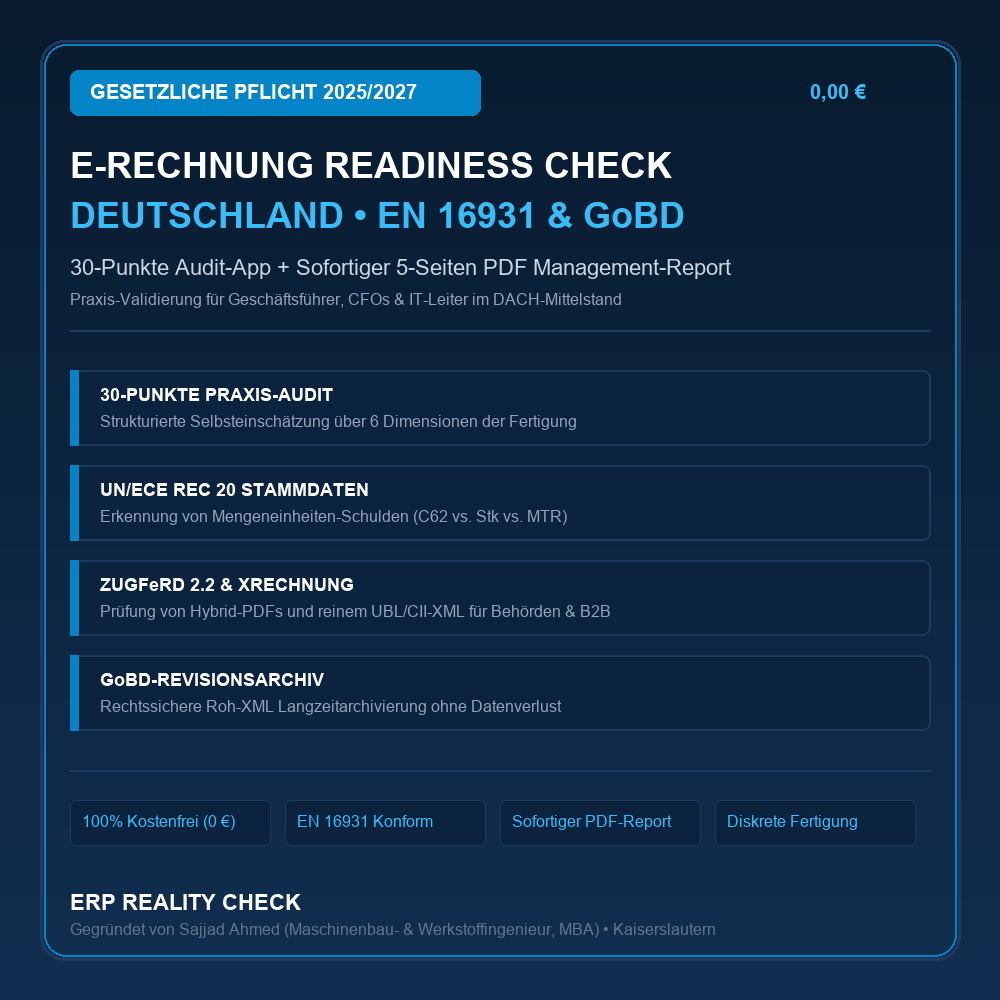
Structured diagnostic assessment for CEOs, CFOs, CIOs, and IT directors in DACH discrete manufacturing. Assess your operational compliance for the German B2B e-invoicing mandate (EN 16931, XRechnung, ZUGFeRD) in 7 minutes – vendor-neutral, actionable, with an instant 5-page executive PDF diagnostic report.
Statutory Mandate & Shop-Floor Operational Reality
Why opening PDF invoices in email postboxes fails compliance, and where manufacturing enterprises encounter friction before 2027.
Statutory Mandates & Timelines (§ 14 UStG)
Since January 1, 2025, receiving structured electronic invoices is mandatory for all German domestic B2B transactions. Starting January 1, 2027, all enterprises exceeding €800,000 revenue must issue structured XML invoices for all outbound sales. By January 1, 2028, all transitional exceptions expire.
Non-Compliance: Payment Delays & RejectionsFormats: XRechnung XML vs. ZUGFeRD
Standard PDFs are no longer legally valid invoices under German tax law. Only pure structured XML (XRechnung via Peppol) or hybrid formats (ZUGFeRD from COMFORT profile / EN 16931) comply. Human-readable PDF views serve visual orientation only; tax auditors examine strictly the machine-readable XML payload.
Beware of the Optical OCR TrapMaster Data Debt & GoBD Archiving
In manufacturing SMEs, portal rejections stem from master data debt: ‘pcs’ instead of UNECE standard ‘C62’, missing buyer PO references (BT-10), or unposted tax codes. Furthermore, GoBD rules mandate tamper-proof XML archiving with immutable indexing and updated procedural documentation.
Audit Vulnerability Without DocumentationIs Your Enterprise Truly Ready for German E-Invoicing – Or Just Your Mailbox?
Opening a PDF invoice on a screen is no longer legally compliant. Since January 1, 2025, receiving structured e-invoices is mandatory in Germany – and starting January 1, 2027, companies exceeding €800,000 B2B revenue must issue compliant XML invoices themselves. Assess in 7 minutes whether your ERP system, master data, and approval workflows will withstand reality – before customer supplier portals reject your invoices.
End the Optical OCR Illusion
Under § 14 German UStG, only the embedded XML payload has legal and tax validity. Relying on optical character recognition (OCR) creates phantom errors, reconciliation lag, and expensive manual rework.
Secure 2027 Issuance Compliance
If your sales order lacks the buyer purchase order reference (BT-10) or your item master uses "pcs" instead of UNECE standard "C62", automated portals reject your invoice and freeze cash collection.
Audit-Proof GoBD Archiving
Printing XML invoices or saving human-readable PDFs in local Windows file folders violates GoBD principles. Verify whether your XML archiving and procedural documentation will pass a tax audit.
Start Free Readiness Assessment
Enter your enterprise profile to receive industry-specific benchmarks under EN 16931 and personalized recommendations.
Loading diagnostic checkpoint...
Executive Diagnostic Report (5-Page PDF)
Your complete A4 diagnostic report with DACH manufacturing benchmarks, non-compliance risk register, and 30-day action plan for executive leadership, finance, and IT.
Germany E-Rechnung Readiness Kit
System-neutral engineering toolkit (Excel): EN 16931 ERP field mapping matrix, 25 manufacturing UAT test scenarios, defect tracking log, and GoBD procedural template.
Confidential Strategy Briefing (30 Min.)
Review your red flags, ERP landscape (SAP, Dynamics, proALPHA, abas, SYSPRO, ERPNext), and interface bottlenecks directly with Sajjad Ahmed – neutral and vendor-independent.
Frequently Asked Questions on German E-Invoicing
Actionable answers for executive management, finance leaders, and IT directors.
Does the e-invoicing mandate apply to all B2B transactions in Germany?
Yes. Under the German Growth Opportunities Act (Wachstumschancengesetz), all domestic B2B transactions are subject to the mandate. Only tax-exempt transactions under § 4 No. 8-29 UStG and small invoices under €250 are exempt. Since January 1, 2025, all enterprises must be capable of receiving and processing structured e-invoices.
Why is sending and receiving simple PDF invoices no longer sufficient?
Under amended § 14 UStG, a simple PDF is legally categorized as ‘other invoice’ and no longer qualifies as an electronic invoice. Without machine-readable XML data complying with EN 16931, invoices issued after 2027 will be legally invalid and automatically rejected by corporate customer supplier portals.
What system modifications are required in our ERP environment?
Key requirements include: (1) XML generation engine conforming to EN 16931 / Peppol BIS 3.0, (2) Item master normalization to UN/ECE Rec 20 standard unit codes (e.g. C62 for units), (3) Mandatory field validation for customer PO reference (BT-10), and (4) Audit-compliant, tamper-proof GoBD long-term archiving for raw XML payloads.
How is our enterprise diagnostic data protected?
All data is processed strictly under Articles 6 and 13 GDPR on secured enterprise servers hosted in the European Union (Germany / Ireland). No diagnostic data is shared with software vendors or third parties. Information is used exclusively to generate your personalized readiness report.
From Free Quick-Audit to Audit-Proof Shop-Floor Operations
ERP Reality Check delivers vendor-independent advisory for DACH discrete manufacturers from initial bottleneck analysis to verified implementation.
E-Rechnung Readiness Checklist
Interactive 30-checkpoint audit across 6 operational dimensions. Instant scorecard with DACH benchmark comparison, red flags register, and 5-page executive PDF report.
- 100% free & immediately accessible
- Audits all statutory deadlines (2025/2027)
- Instant executive PDF report for Board & CFO
Price: €0.00 (Permanent Free Digital Lead Tool)
Manufacturing ERP Operations Toolkit
Ready-to-use Excel models, shop-floor audit checklists, scrap latency models, and VDI-compliant functional specification templates for operations leads and controllers.
- Excel Shadow IT cost audit calculator
- Scrap & rework latency quantification model
- Standard Operating Procedure (SOP) blueprints
Price: €69.00 net (Instant Download)
10-Day ERP & Operations Diagnostic
Structured on-site physical walkthrough and data reconciliation. Uncovers root causes of shop-floor friction, inventory discrepancies, and rogue spreadsheets without software vendor bias.
- Physical work center & shop-floor inspection
- Book vs. physical stock variance audit
- Quantified Bottleneck Matrix & 90-day roadmap
Price: From €4,500 (Fixed-price diagnostic sprint)
Frequently Asked Questions
Transparent answers regarding methodology, software compatibility, and delivery.